

Behind Closed Doors
Rahman woke before the azaan, the room still thick with sleep. The fan above him clattered like a lazy insect, slicing the humid air without relief. Lying beside him, his wife’s breathing was heavy, turned toward the wall.
He remembered their first night in this room, six years ago. Ayesha had lain exactly like this, facing the wall. Her body rigid with pretending. The city had roared outside like an animal they didn’t know how to name. She had cried silently, her shoulders shaking just enough for him to notice. He had touched her arm, and she had flinched.
In the village, they had slept with the windows open, the sound of coconut trees brushing against each other, the distant call of foxes from the fields. Here, the windows stayed shut against the noise, and the walls sweated dampness even in winter. He had held her hand that first night and whispered, “Six months. Maybe a year.” He had believed it then.
Across the room, in another bed, a hand spread out, dangling off the edge. He walked over and gently tucked Naima’s hand closer to her sister, his youngest, Meem. Meem slept on her stomach; arms wrapped around her schoolbag as if it were a bolster. Its zipper was broken, pencils poked out like a hedgehog’s spines. One had rolled under the bed. Rahman stooped, picked it up, and slid the bag gently out of her embrace. He tucked it beneath the bed where it wouldn’t soak with her sweat.
The alley smelled of yesterday’s rain and jackfruit skins tossed in the drain. Somewhere down the road, a rickshaw bell rang twice, followed by the faint cawing of a crow. Rahman bent over the courtyard pump, splashing his face with the iron-tinged water. Though they had an attached bathroom in the house with stored drums of water, Rahman preferred the deep-well water. It tasted of earth, of something older than the city, and for a moment, with his eyes closed and the cold against his skin, he could almost believe he was back in the village, drawing water from the tube well behind his mother’s kitchen.
As he mopped his face with his palms, he was alarmed. So, then came the ritual: soap against stone, grinding at his palms until they stung. The smell of the day before would not leave. Bleach. Ammonia. Shit. But the scrubbing was his shield. He could walk back into his house after the day’s labor and hold his daughters without disgust.
When he pulled his faded shirt over his head, Ayesha stirred. She rose without speaking, her feet bare on the cold floor, and disappeared into the tiny kitchen. He heard the clank of the pot, the hiss of the stove.
From under his pillow, he retrieved his tupi, a small white cap, soft with age, its fabric thinning near the edges. He brought it to his mouth and breathed into it, a quick warm puff, then placed it over his head. His palms, coarse and cracked, pressed down on the cloth, smoothing it against his scalp in slow strokes, then stepped out.
The alley had changed. The soft grey of early dawn had sharpened into something harsher. Light fell in slants between the buildings, catching the dust that hung in the air. A rickshaw clattered past, ringing its bell urgently. The tea stall at the corner was open now, a cluster of men gathered around it, their voices rising and falling in the familiar rhythms of morning. A man emptied a bucket into the drain, water splashed, carrying vegetable peels and something white and floating. The crow was back on the wire, watching.
At the mosque, he slipped off his sandals at the entrance and joined the row of men. There were only five of them, scattered across a hall built for forty. The fajr prayer was always thin; the ones who came were the old, the burdened, the ones who could not sleep or who sought something before the day swallowed them whole.
The imam’s voice echoed against the empty walls. Rahman sometimes thought about the ones who stayed in their beds, the ones who would pray later when the sun was high and the obligation lighter. He did not judge them. But he was here, and they were not. That was all.
The prayer was quiet, intimate, bodies bending and rising together, foreheads touching cold stone. When it ended, they dispersed without words, each returning to his own morning.
Back in the house, the day had grown brighter. The noises from the alley pressed through the window, a vendor calling his price, a baby crying somewhere, the grinding of an engine struggling to start. Rahman paused at the threshold and looked at the table where he would eat.
It was good wood, shegoon to be exact, dark and once polished, but old now. It had come with them from the village, strapped to the van that first terrifying journey along with whatever else they could carry, and it bore the marks of that passage. One leg was shorter than the others. Even with a folded piece of calendar paper tucked beneath one leg, the table rocked gently if you leaned on the wrong corner. Its surface was faded, the grain risen in places, a dark ring stained into the wood where a pot had sat too long. It stood beside the bedroom door, taking up space they didn’t have, a piece of home in a room that would never be one.
Ayesha came back with a steel plate. On it sat cold rice soaked in water, a heap of komli shaak sautéed with garlic and green chilies, and some white pumpkin curry from the night before. He ate quickly, bending over the plate, his fingers moving with the efficiency of habit. The food was good. It always was. But he did not taste it.
When he finished, he stood at the door and looked back. Naima had rolled onto her stomach, the dangling hand now on her sister’s back. Meem’s bag still peeked from beneath the cot, pencils like spikes. Ayesha had returned to bed, her back to the room, her breathing already evening into sleep. He watched them for a moment, his three women, most of his world in a single room, then stepped out and closed the door gently behind him.
The office was a fifty-taka rickshaw ride away, but Rahman walked. Past the tea stalls just opening, past the man sweeping the front of his shop with wide strokes, past the sleeping bodies still curled on footpaths. He walked with his head down, the bag with his tiffin carrier and water bottle swinging against his leg.
Fifty taka was two days of vegetables. Fifty taka was treats for his two girls. He walked.
The building rose at the end of a wide avenue, glass and steel glowing like the gates of heaven. Men in polished shoes walked through the big revolving doors, their briefcases swinging, their shirts crisp. A woman in a white blazer and pointed heels hurried past him, her phone pressed to her ear. Rahman paused at the edge of the pavement and looked up. The building went on forever, its windows reflecting a sky that seemed bluer here than anywhere else in the city.
He had been through those doors once. Seventh floor. Executive washroom. He remembered the carpet beneath his feet, so thick his shoes left prints. The way the air smelled different up there, not of sweat and detergent, but of something clean and cold, like flowers preserved in glass.
A man had walked past him once, a little girl in a school uniform holding his hand. “This is where Baba works,” the man had said, gesturing at the wide windows, the gleaming desks. The girl had pressed her nose to the glass and gasped at the cars below, so small, so far.
“Baba, do you sit here and look at the clouds all day?”
“Sometimes. But mostly I work so you can have pretty things. Like your new school bag. Remember?”
“The one with the butterflies?”
“The one with the butterflies and the one with rainbows and the one with barbies. Come, let me show you where I keep your drawing on my desk.”
The little girl in her small voice kept asking a bunch of confusing questions that made her father laugh heartily and even brought a smile to Rahman’s face who was mopping with his ears open. He could hear the man laughing inside, the girl’s high chatter. He stood there, his mop dripping onto the carpet, and tried to imagine himself on the other side of the door. Tried to imagine little Meem’s face if he brought her here, showed her this building, said the words: this is where Baba works. But the words would not form. They stuck in his throat like bones. Because this was not where he worked. He worked in the spaces the building forgot. He worked where the polished people never looked. And if Meem ever came here, she would not see him behind a desk. She would see him on his knees.
Today he did not go through the revolving doors. He walked to the side, where the glass gave way to concrete, and found the wooden door at the corner. It was old, painted brown once but now faded to the color of dust. No handle, just a push plate worn smooth by years of palms. He pushed.
Inside, the air changed. The cool of the lobby, with its marble floors and soft music, did not reach here. This corridor smelled of detergent and sweat and the electrical hum of old machines. A row of time clocks lined the wall, their faces round and tired. Rahman pulled his card from his pocket and slid it into the slot. The machine clicked, stamped, and he pulled it out without looking at the time. He was always on time.
In the changing room, metal lockers stood in uneven rows, their doors dented, some hanging from broken hinges. He unbuttoned his shirt slowly, the one Ayesha had ironed, the one that proved he was a peon in a reputed office, and hung it on a hook inside his locker. From the hook beside it, he took the other uniform: a pale blue shirt with the company logo printed large on the chest and pulled it over his head. The fabric was polyester, industrially washed a hundred times. The logo sat on his chest like a brand.
At the counter, a man with a clipboard looked up and grunted. Rahman gave his name. The man checked a list, then pointed to the corner where the backpacks sat in stacks. Big blue ones, each with the same logo, each filled with brushes and chemicals and rubber gloves. Rahman took one, tested its weight on his shoulder, and walked out through the wooden door.
Behind him, the building rose into the sky. In front of him, the city waited. He stepped into it, the logo on his chest facing forward, the backpack heavy against his spine.
The app buzzed on the bus. The cracked screen lit up with a fresh task: “3 bathrooms, Dhanmondi. 4 pm.” A good neighborhood. Maybe the residents would tip.
But that was hours away. Two other tasks, rescheduled from yesterday, waited before it. The first was in Mogbazar, kitchen deep-clean for a middle aged-woman in a building that smelled of fish fried in stale oil.
For the next two hours he worked on his knees, scraping years of grease from tiles, the chemical burn sharp in his throat, even through the rag tied over his nose. The lady of the house brought him cold water once, knocking on the closed kitchen door and setting the glass on the floor outside the kitchen, then retreating without a word. He drank it slowly, the glass cool against his palm, and for a moment the water tasted not heavy but of something like mercy; brief, anonymous, gone before you can thank it.
When he finished, the tiles gleamed like new. The lady paid him exactly what the app showed, no more, and closed the door before he could reach for the elevator button.
His next stop was Mohammadpur. The client was a boy in his early twenties who barely looked at him, too absorbed in his laptop. He walked him into the tiny flat and pointed in the direction of the bathroom. Which was a swamp. The smell hit him before he pushed the door open, something sweet and rotten, the smell of water that has sat too long. The floor was slippery, the drain clogged with hair and things he chose not to name.
Rahman plunged his gloved hand into the clogged drain, felt the cold slime of hair and things he didn’t identify, pulled until the water began to drain. He scrubbed the floor on his hands and knees, the boy’s music playing somewhere beyond the closed bathroom door. The water he wrung from the rag was the color of old tea. He wrung it again, and again, until it ran clear. He worked in circles, the way his mother had taught him to sweep the courtyard; from the corners inward, never leaving a spot untouched. When the floor finally came to life, he sat back on his heels, wiped his face with his sleeve and called out to the boy.
The boy did a quick inspection, popping his head into the bathroom, then made the payment through the app while walking him back to the main door. Rahman gave him a Salam, though the boy had already turned away and shut the door.
Rahman went down, found a good spot on the road—a low wall outside a shuttered shop, just enough shade from a billboard overhead, and sat. From one of the compartments of his backpack he took out his lunch. It was sealed in layers and layers of cellophane. Ayesha wrapped it like this every morning. The oil never leaked. The smell never escaped. And later, when he opened the backpack again, the food would taste only of itself.
He unpacked the carrier slowly, the crinkle loud in his ears, and found rice under a small mound of vegetables and a boiled egg curry with a pinch of salt in a folded corner.
He ate watching the traffic, then dashed off to catch a running bus.
The bus rattled down Mirpur Road, packed with bodies. A woman selling cucumbers and carrots pressed her basket against his arm, a student with dangling earphones leaned into him, muttering to himself. Rahman held his bag tight against his knees and stared out the window.
The city flashed past in its endless violence. Shopkeepers dragging in customers, groups of confident women walking to the nearby garments, men of all ages taking a piss wherever they found it convenient. At a bus stop, a girl waited in a blue school uniform, her hair in two braids, a bag on her back. She was laughing at something on her phone, her whole body tilted with it. Naima’s age, maybe. He watched her until the bus lurched forward and she disappeared into the crowd.
Naima was different. Seventeen, quick-tongued, restless. Last year, when her mother mentioned a suitor, she had thrown her schoolbooks across the floor.
“Not me! I want to study!”
“Study? With what money? With whose permission? You think books appear from the air?”
“I don’t care! I’ll find a way.”
“You live in my house, eat my food…”
“You didn’t study— that doesn’t mean I won’t!”
Her mother slapped her. Naima slapped the floor back with her books, hard enough to startle the neighbors.
Rahman had said nothing then, but a corner of him had glowed. She would not end like Nila; married at nineteen, her voice already carrying the weight of another household’s rules. Nila had studied only until class six. Her mother had said it was enough. Rahman hadn’t argued. He rarely did. But lying awake afterward, he had wondered if one word from him might have kept her laughter from turning into that tired voice on the phone.
Naima would be different. She would study, she would become something, she would step out of this tiny house into a life he could not even imagine.
And then little Meem, barely five, who would climb onto his shoulders and call him her horse, tugging at his ears as reins. She was his second chance at dreams, though he never said that aloud. When she slept, he sometimes watched her face and imagined all the doors that might one day open for her. Doors he would never walk through himself, but perhaps, if his back held out, if the work continued, if Allah was kind, he could hold them open long enough for her to pass.
The bus jerked to a stop, tossing him against the lady vendor’s basket. He murmured an apology and climbed down, the backpack knocking against his shin. The address was in Dhanmondi, wide roads, tall buildings set back behind walls topped with glass, trees planted in neat rows. A different world. He walked toward it, toward his next destination.
The flat was on the third floor of a building that smelled of dust and damp cement, but a different kind of damp, the damp of new construction, of paint still curing, not the old sweat of walls that had breathed too many lives. Curtains were drawn tight, a Hindi song thumping from inside, the bass vibrating through the door.
A young man answered. He looked as if he just came home from a long day at the office. He had on a formal shirt that had half of its buttons undone, his belt buckle dangling open. On his feet, flip-flops cupped his soles that were still trapped in dress socks, the fabric bunched where he had kicked off his shoes without using his hands. Behind him, the hallway stretched longer than any Rahman had seen in a home. Three doors. Maybe four.
Inside, the air was cloudy with cigarette smoke. Two empty cartons of biryani and crumpled cigarette packets covered the dining room table, the good kind of biryani, from a restaurant Rahman had seen in a glass window once, the prices unimagined. On the massive television, a woman danced in a glittering napkin-like dress that barely covered her treasures. The sofa was deep, leather, the kind you sank into and couldn’t get up from easily. A laptop sat open on the armrest, its screen dark. A pair of women’s shoes lay toppled near the door.
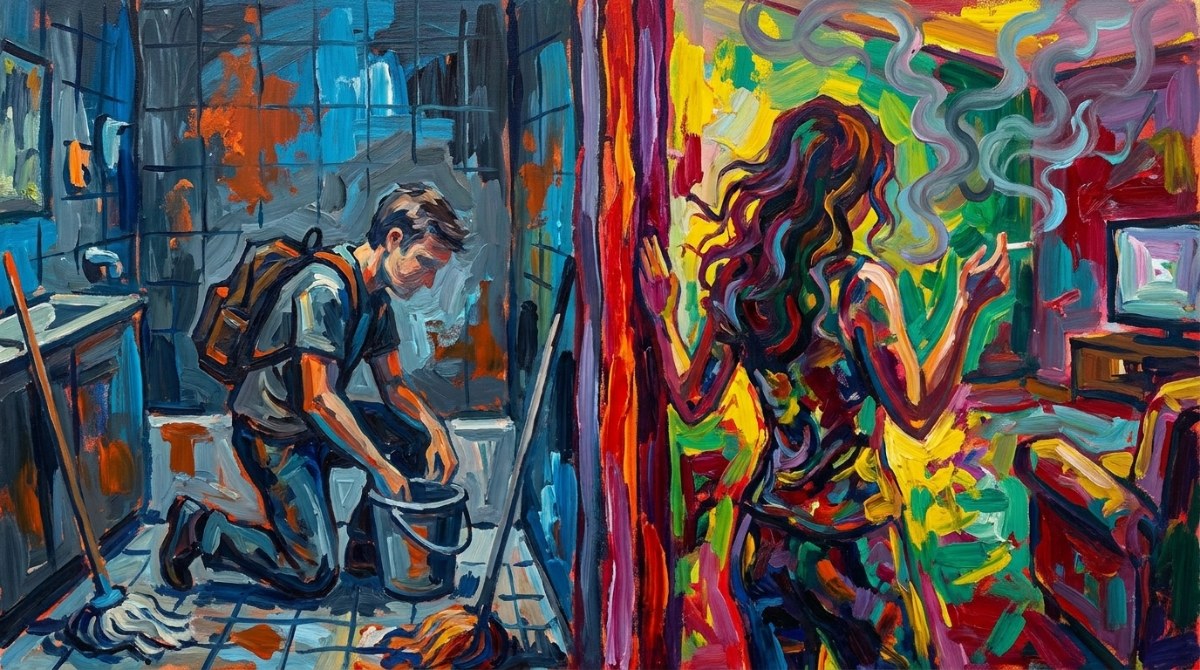
The first bathroom was off a long hallway. It was large, larger than the room he shared with his wife and daughters. Pale green tiles like the inside of a seashell, a mirror that ran the length of one wall, a glass shower cubicle big enough for two people. But the toilet was ringed with yellow, the floor sticky with spilled things, a wet towel crumpled in the corner. He tied his rag over his nose and bent onto his knees. Scrub, rinse, scrub again. The scrape of his brush was the only sound against the thrum of music outside.
The second bathroom was worse. A clogged drain sent up a sour smell, not just hair, but something older, something that had been sitting too long. He plunged his hand in, felt the cold slime close around his rubbered fingers, pulled out a clump of long dark hair dripping with filth.
By the time he wrung the last rag, the light had shifted to a harsh white, pressing against the curtains.
One more and he’d be done with his shift. The thought of that suddenly gave him such a boost of energy that he didn’t mind that the bathroom was double the size of his house, fitted with a bathtub and two sets of sliding doors which were like extra walls he’d need to scrub besides the other four. The bathtub alone could hold three children. He had seen such things only in films, in the glossy magazines the street vendors sold wrapped in plastic.
The third bathroom was the largest he had ever cleaned. A bathtub like a white coffin. Sliding glass doors that threw his own face back at him—tired, faded, a stranger's. Tiles so polished they seemed to glow from within. But he worked quickly now, the end near, his body moving with the efficiency of long practice.
From somewhere beyond the closed door, muffled by walls and the thump of music, he heard voices. A man’s first, low and teasing. Then a woman’s laugh in response, light, genuine, the kind of laugh that belonged to no one in particular but made him pause with his brush mid-stroke. He could not make out words, only tones.
Rahman worked through it all. Through the way the woman’s laugh reminded him of something he could not place. Through the way the man’s voice carried a tenderness that made him think of holding Ayesha’s hand that first night in the city, promising her six months.
When he finished, he packed his brushes, his rags, the half-empty bottle of bleach. He stood by the bathroom door, waiting, his backpack at his feet.
The young man who had opened the door appeared at the end of the hallway, swaying slightly. Rahman raised a hand to catch his attention.
“Sir. Please have a look.”
The young man stumbled toward him, glanced into the first bathroom, then went over to the second. At the third, he paused, running a hand along the glass door. He nodded, then patted his pockets. Frowned.
“Ai! Bring my phone! From the table!”
She came around the corner, a cigarette between her fingers, his phone in her other hand. She was laughing at something, perhaps something on the television, the laugh still dying on her mouth as she looked up.
She saw him.
The laugh stopped. The cigarette hung in her fingers. The phone rested in her palm like something heavy.
Rahman’s breath stopped. Naima. In this place. With this smoke. With this man. Holding his phone like a servant, like she belonged here, like she was a member of the house.
Her eyes moved over him, the logo on his chest, the backpack at his feet, the rag hanging from his pocket.
He saw it happen: the moment she understood. Not just that he had seen her. But what he was. What he did. What the logo meant. Her father, on his knees in other people’s filth.
She did not speak. Her mouth opened, then closed. The cigarette sent up a thin line of smoke.
He did not speak either. What could he say?
She would not look at him now, her eyes fled from walls to floor to walls again, landing nowhere, anywhere, everywhere but his face.
He could not look at her either. His eyes stayed low, fixed in his gaze but scrambling in mind while the cigarette smoke curled between them.
For one breathless moment, father and daughter faced each other without their masks.
The young man took the phone from her hand, grunted something, and made the payment. The app buzzed in Rahman’s pocket. The transaction was complete. The job was done.
Comments · 0
Sign in to join the conversation.