

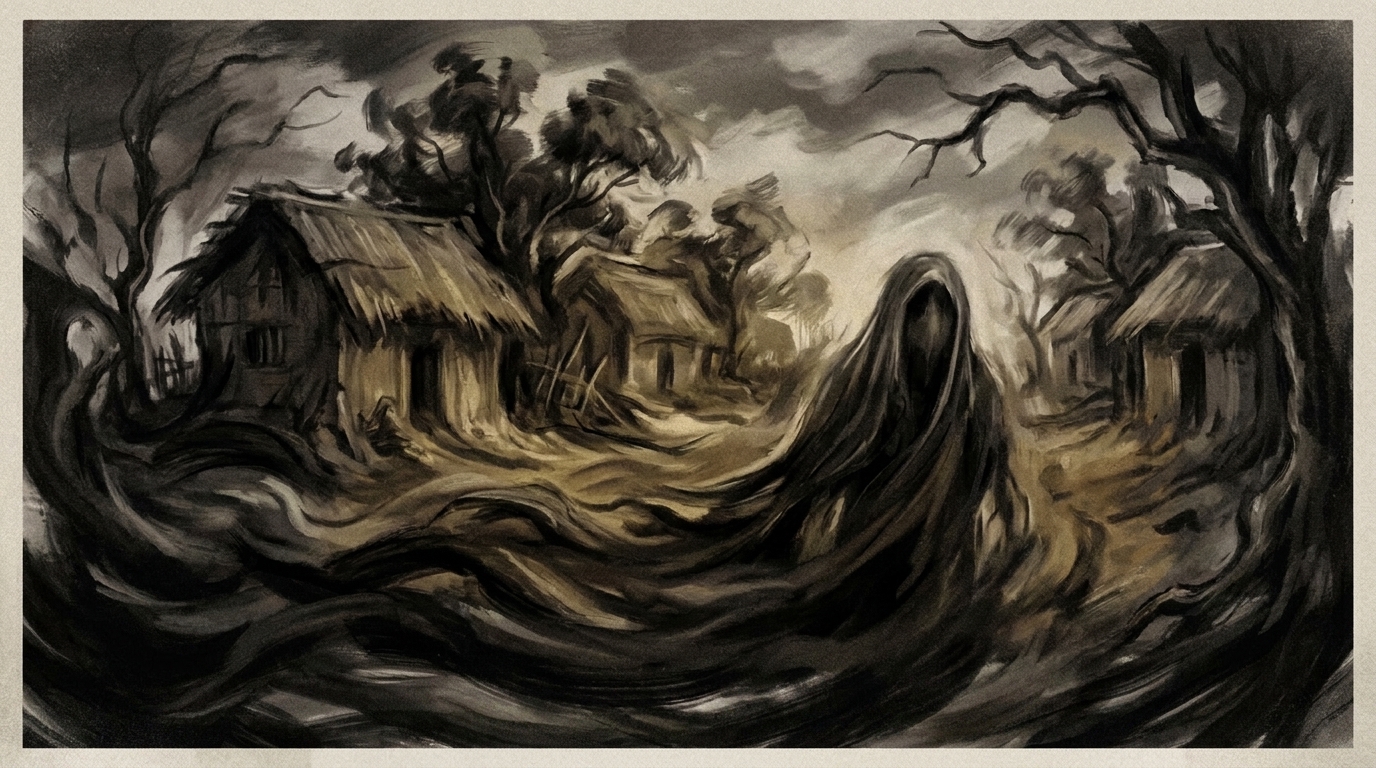
The Curse Of Joshpur
It all began with Hunger, as many curses do.
But one thing I’ve learned in my life is that hunger does not always live in the stomach. It curls itself into the soft corners of the heart, sometimes, hides behind the obedience or shrouds itself in silence. Hunger has many names, many forms. And when it screams, it doesn’t always use a mouth. Its cries can echo through bloodlines, crawling under the skin like memory, dragging its misery through generations, until someone mistakes it for fate.
My brother’s wedding was rushed, and my mother was panicking the entire time. I asked her, “What’s the rush? Why are you so restless?” But she kept repeating one line: “I don’t want him to end up like his ancestors.” I was very young then and didn’t ask many questions. Six months after my brother’s wedding, my mother died. But that sentence stayed with me. She didn’t want him to end up like his ancestors. What did she mean by that? I began to wonder. The only thing I could see was that my Chachchu never got married, he lived with us until his death. I’d heard of Dadumoni’s brother, who also never married. That’s when I began asking questions.
I asked my father what he remembered. He couldn’t recall much. But from one story to another, I started getting my answers. Piece by piece, the story started to unspool, but not in a single thread. It came in shards of cracked porcelain, bits corrected, recounted, and patched together by my father. I began to recall fragments from my own childhood, when my mother told me tales of her mother-in-law , my grandmother. My mother’s voice, those echoes from childhood, were so loud that I had to listen carefully for what remained unsaid. One word kept surfacing: there was a curse in the family. I began to write it down. Not because I believed in curses, but because I wanted to understand where I came from and what followed me here.
Toiyob Ali was my grandmother’s brother. Until he turned thirty-five, he insisted on calling his choosiness “standards.” At least, that’s what he called it.
He said no to girls with thin eyebrows. No to girls who didn’t have long hair. No to girls who weren’t fair. No to girls who couldn’t cook polao rezala without supervision. No to girls who didn’t speak softly. No to girls who spoke too softly, as if they were hiding something. No to girls with a mole on their chin, he said they’re unlucky. No to girls with a mole on their forehead And God forbid they had no mole at all, then they were just “plain.”
Two of the girls were still in school, one finishing her SSC, another already teaching English at the girls’ school. The third had a home-based tailoring business and earned more in a month than Toiyob could make selling jute sacks. “She’s got big dreams,” he muttered to his mother after that meeting, flicking ash off his biri.
His mother sighed. “But she’s sweet. She made that semai with her own hands.”
“One plate of semai won’t change the fact that she wants to fly with her dreams, Amma. “Next thing you know, she'll make me wash her blouse”.
By thirty-five, three excellent matches had fallen through. Word began to spread in the tea stalls and at the weekly haat. “If he's this picky, he won't need to marry at all.” Some old women clicked their tongues. Some old men muttered, “The jute sack king wants to marry a queen now!” "It seems like that boy is jinxed," they whispered, standing around the yard.
By forty, the bitterness had grown into something uglier. He once knocked over a tea stall at the hatbazar because the shopkeeper asked him to pay first. "You think I'm broke like the rest of you?" he screamed, kicking over a stool. "I owned land when your father was still in diapers." One afternoon, at the weekly cattle market, he tried to bargain for a cow and got rejected by a young seller. “You’re not strong enough to keep this one, Mama,” the boy said with a smirk. The next morning, the boy found his cow loose and wandering near the canal, tether rope sliced clean.
People began to avoid him . Not out of fear, but exhaustion. Mothers whispered to their daughters to walk faster if he was spotted. Children gave him nicknames. Still, he was not yet fully discarded. His business grew big, managing jute sacks and turmeric transport deals. He wore expensive kurtas and hosted village elders with tea and sliced guava. But the damage to his name had been done. And the women, the ones who might’ve softened him, never came back around.
At fifty-two, he showed up at the neighbour's house with a proposal for their youngest girl who was just sixteen. Her family refused before even letting him in. That week, someone scrawled in chalk on his boundary wall:
“পাগলের বিয়ে হয় না, শয়তানের বাড়ি ঘর নাই।”
(Madmen don’t marry. Devils don’t build homes.)
After that, Toiyob Ali stopped showing up at weddings altogether. But then, there was a girl who almost married him. But she vanished the night before the wedding, leaving only a note that read: "I cannot marry into that family. I have seen the one with the black burkha in my dreams.”
My great-grandmother Hazera Bibi, seeing her son’s situation, always used to mutter, “I should’ve gone to the cowshed that night, then this wouldn't have happened.” Nobody understood what she meant by that.
Toiyob Ali died at the age of seventy-five. Never got married. Died a virgin.
The firstborn of Dadumoni was Shamsul Haque. He worked in Dhaka, behind Bangla Motor, in a modest office where the walls smelled of ink and old paper. He wasn't ambitious, but he was dependable . Shirts always pressed, hair always neatly parted, handwriting so clean it looked like a printed type.
He fell in love with his cousin. Quietly, but, cautiously, the way men do when their hearts are unsure if they’re allowed to want. She was graceful, always smiling with her eyes before her lips. Everyone in the family thought it was only a matter of time. She even offered him tea once in front of her mother — a small act, but in village language, it meant “I like you.” The girl’s family was happy.
One morning, she came to their house with her mother and returned the shawl Shamsul had once lent her. She didn’t look him in the eye. She spoke only to Dadumoni. “I cannot marry him,” she said flatly, her voice shaking at the edges.
Dadumoni frowned. “Why not?”
The girl hesitated. Then, with a voice quieter than the wind in a cornfield, she said: “I have seen the one with the black burkha in my dreams. The dream felt like a warning. I am sorry, I cannot marry your son.”
She didn’t stay for tea, and within a month, she was married to a teacher in Comilla, Durgapur. Her family didn’t fight the decision. Warnings in dreams were stronger than logic back then. Chachchu didn't argue either. He just stopped speaking about marriage altogether. A few weeks later, he told his mother in a single sentence: “I won’t marry. Ever.” And he didn’t. Not even after fifty.
He lived a long, quiet life. He wore the same shirt until the collar frayed. He grew old with bitterness carved into the lines of his face. People said he was unlucky in love, but nobody knew the story to know any better. Nobody knew that his fate was sealed long before he was born.
Dadumoni hadn’t slept a minute that night. Something was wrong. She said later she felt it in her joints, like the bones knew before the mind did. Around midnight, she noticed Mota Mia acting strange. Mota Mia was no ordinary bull. He’d been bottle-fed by my grandmother after his mother, a prized Gabhi, had died of fever. He never needed a stick to be guided. He followed my father like a shadow, licked his elbows while he washed rice, and huffed through the kitchen screen whenever lentils were boiled. A gentle creature, Until that night..
Dadumoni saw him through the slats of the window — twitching, snorting, looking sideways as if being followed by something that wasn’t there. She tried to wake her husband, but he waved her off. Everyone was asleep.
At 3:04 AM, a low moan echoed — the sound of rope tightening, the rustle of straw disturbed by something with weight, but no footsteps. Grabbing the hurricane lamp, Dadumoni stepped into the yard. What met her eyes froze the breath in her chest. The cowshed door creaked open, not swinging but drifting, as if moved by breath itself. Something floated out.
A shape wearing black, hooded and veiled, the burkha rippling as if caught in wind, though the air was still. The figure passed over the threshold like smoke given form. As it crossed the straw, it never touched the ground. Just a faint shimmer beneath the hem. And then; it paused at the neem tree. Turned its head toward her. There was no face, only heat, like looking at fire through black silk. Then it was gone.
When she finally dared to breathe again, stumbling back inside, the first thing she did was lock the door. Sleep did not come. After Fajr azan, as the first blue of morning touched the yard, she returned to the cowshed. Mota Mia was lying on his side. He was still, eyes open and tongue out. Her hand touched his belly, and she jerked back with a cry. A gaping hole, torn in a circle, straight through the stomach wall. No blood. No mess. Just an empty hole inside the belly, like something had reached inside and claimed him. The world tilted, the lamp slipped from her grasp. She blacked out right there.
Dadumoni couldn’t take it anymore. Her son had already joined the ranks of the cursed. There was no coming back. But, Mota Mia was the only one standing between that thing and her grandson. And Mota Mia was gone. And so, one night-not in a fit of fear, but a quiet panic stitched into her bones-she sat my mother down on the veranda. She told her everything. Not her son. Not her husband. My mother. The woman who had just given birth to a son. “Listen to me carefully, it started with my mother…”
And somewhere in that night, through whispers passed between women, through a story folded into the creases of moonlight and mosquito nets,the tale became mine, a tale my grandmother never told me.
Hazera Bibi, my great-grandmother, had 13 babies. The firstborn was Toiyob Ali, my grandmother’s brother. He was loved the way firstborn sons are loved.
It was a dark evening, and the wind pressed against the bamboo slats like it wanted to be let in. Inside the mud house, Hazera Bibi sat cross-legged on the cool earthen floor, her knees stiff from the day’s work. The children had been fed, their steel plates licked clean of lentils and mashed potato fried with mustard oil. Even little Toiyob had eaten double portions today. All that remained now were three empty bowls stacked upside-down on the corner shelf beside the clay water pitcher. A single hurricane lamp flickered beside her, its glass fogged with soot. The flame danced like it knew something was about to arrive.
She was just finishing her nightly tasbih when the knock came-slow, deliberate, not the knock of a neighbor.
KHATAK KHATAK KHATAK!
Hazera froze mid-prayer. The house was quiet. Her husband had long gone to bed. The babies were asleep, belly full. She glanced at the wall clock. Just past 8PM. Still early by village standards. But the silence outside was too thick. She pulled her orna over her chest and walked to the front door. As she unlatched the bamboo frame, the hinges moaned.
There stood a tall figure in a black burkha, loose, long, frayed at the hem where it touched the mud. No eyes visible. Only a shadowed slit in the veil. The lamplight spilled weakly onto the figure’s feet-bare, cracked, dusted in ash.
"I haven’t eaten for three days,” the voice said, hoarse but smooth. “Could I have some food?"
Hazera blinked, trying to determine the shape under the veil. The chest was flat like a man, but the height did seem tall like a man. Though, the stance was graceful, hips shifting side to side like a woman swaying at the pond. So feminine, so elegant. There was something unnatural about their stillness . It was not rage but something unnamed that hummed under the skin, as if they lived only for the act of wanting.
“I had some rice left,” she answered, her voice thin with uncertainty. “But my elder son ate it all. Forgive me, but I have none left.”
“Forgive you?” the figure replied, tilting their head. “That’s what you say when you see a beggar-you ask for forgiveness. What forgiveness can I give you, my dear? I have none left.”
Hazera stepped back, one hand tightening around the hurricane lamp’s handle.
“I said, forgive me. Please leave. There is nothing more here.”
The figure did not move. They said, “My bed hasn’t been warm for many years, You seem to be alone in the house. Your husband and children are asleep. I see the cowshed is empty. Let’s go inside together, feed my hunger, and then I will think about forgiveness.”
Hazera’s breath caught in her throat. “How dare you say something like that?” she spat on them, their black burkha got filled with dribbles of saliva. She grabbed the straw broom from behind the door and charged at the stranger, swinging it with sharp, slapping sounds across their shoulder, “Chhi! Shame on you! Go on! Leave! Shoo! You motherfucker. You bloody swine!”
The figure stumbled back once, then straightened, "Fucker I am not,” they said. “Swine I can be. Bloody? Sure.”
Then they raised their hand! Not to strike, but to point. The air around them grew thick, humid, as if the house had sunk underwater. The light in Hazera’s hurricane lamp flickered wildly, throwing shadows that made the walls crawl. And then the figure began to speak. Not shout, not chant, but something in between. The words didn’t echo, but they started landing like fragments of a comet.
“I come, driven by hunger, and you offer only forgiveness. I crave your warmth, yet you answer with contempt and spit.
Upon your lap rests the innocent—let his fate be bound to mine, for your trespass with me must haunt your son.
Let him never build a home with another, nor feel the solace of shared nights. Let him wander unloved and unnamed, as I do, his memory swallowed by silence on the day of the dead.
By the oil in your lamp and the grain beneath your roof, I bind your firstborn.
On your threshold, I lay this hunger; beneath your floor, I utter this doom.
Let my hunger hollow every hunger your firstborn ever knows.”
“The wind outside had stopped. The air inside had not moved since. Twenty years passed after that night. Twenty years is enough time for a curse to settle its back against your wall and act like furniture. It’s still haunting us.” said my grandmother to my mother. My mother listened in silence, but the fear had already taken root. It wasn’t a story anymore—it was a pattern. And her son, my brother, was next in line.
She had heard the stories, first whispered by her mother-in-law. She had seen Shamsul Haque fade into himself like a man slowly drowning on dry land. She had heard about Toiyob Ali’s long, lonely years. She had seen too many eyes dart away from hers when she asked what really happened to Mota Mia.
Three days after my brother was born, she decided to go back to Joshpur. My mother was not superstitious. She was educated, sharp-tongued, with a logical brain and a voice like sharpened steel. She spoke English better than her principal. She read Marquez. But she believed in patterns. And this one terrified her. She just knew she would get the answer if she could get a hold of this one with the veil.
She packed light. Just a small suitcase, my brother’s clothes, a few gold bangles, and the feeling that something unfinished was waiting for her.
She returned to Joshpur. Of course, she had no guarantee the veiled one would appear. It had been decades. No one had seen them since Mota Mia. Maybe they were gone. Maybe they were never real. But then again, my mother was the most beautiful woman in all of Comilla. People said she turned heads without trying. But beauty is not what drew the veiled one. It was her cooking.
The morning my mother was to return to Dhaka with my newborn brother, she woke up early, bathed in well water still cold from the night, and changed into a fresh white cotton saree. She braided her hair tight and placed a thin smear of sandalwood on her forehead.
She went into the kitchen hut and began cooking-not just rice, but a proper meal. Polao, slow-roasted with cinnamon and bay leaves. Chicken rezala, tender in thick white gravy. She boiled borhani and chilled it in a brass tumbler. She ground the spices herself with the pestle, her wrists moving like clock springs. All the while, she watched the road through the half-open kitchen door, the sunlight filtering in between neem leaves. She was tired from all the cooking and all the work. She fell asleep. At exactly 3 a.m. there was a sound.
KHATAK KHATAK KHATAK
They just stood there, leaning slightly against the neem tree, the same black burkha covering their body like before. Only this time, they wore a hood over their head, drawn low, but not low enough.
My mother wiped her hands on her saree and walked out with the tray, balancing it like it was an offering.
They took everything, then ate all the food really fast. Drank a whole jug of water, then smirked at mother and said,
"So, are you bribing me then?"
My mother set the bowl down carefully, watching them eat. "Can I? Will that work?"
They chewed slowly, savoring each bite. When they finally looked up, there was something almost sad in their eyes. "Well, I am not hungry anymore, but I can't take my words back either."
"Don't you think the sins you claimed were made have followed this family enough? Don't you think it's time to stop?"
They were quiet for a long moment, staring at the empty bowl. "It doesn't matter what I think. When it's out there, it's in motion. Stopping is not possible. The only thing you can do is divert it."
"Divert to what? To another family?"
"Maybe."
"That's not fair."
They stood up slowly, brushing crumbs from his clothes. "You can have it all, woman. But I am happy with your hospitality." They paused, looking directly at her. "I cannot take back the curse. But you can ask something from me and I will try to give it to you. How can I say no to she who begins what I cannot name?"
"What do you mean?"
"You will know." They moved toward the door, then stopped. "I will go now. If you want to ask anything, this is your chance."
My mother's words came out in a rush: "My firstborn is a son. I don't want him to go through the same fate. I want him spared."
"Done!" The word came quickly, almost cheerfully. He stepped back from the doorway. "Thanks for the food. Your son will have a long married life and live happily and he will travel the world. My fate won't follow your son." They tilted their head, studying her face. "So that’s why your daughter is so pretty, she’s got your genes."
"I don't have a daughter."
They tilted their head again. “Hmm. She looks exactly like you.”
My mother's eyes narrowed. "If this curse follows my son, I will find you again, you do know that?"
They smirked again.
My mother turned toward the house. "Wait here, I have something else to give to you."
She hurried inside, searching for the small pouch of money she kept hidden behind the rice jar. Her hands shook as she counted out the bills. It was enough for several good meals, maybe a place to stay for a few nights. When she returned to the doorway, the money clutched in her palm, the threshold was empty.
She stood there for a long time, staring at the spot where they had been, the evening air carrying only the distant sound of crickets and the faint smell of jasmine from the neighbor's garden.
Years later, my brother got married. The ceremony was grand-hundreds of guests, musicians playing until dawn, my brother's face glowing with happiness as he lifted his bride's veil. The curse had finally lifted. It's been 11 years now, and my brother is happily married. His wife is very beautiful, loving, and takes care of him. He is living abroad now, sending us photos of snow-covered streets and foreign festivals, his smile never fading.
I was born seven years after that encounter between my mother and the veiled man. For years, I didn’t even believe in it. It was just a village myth, a family embarrassment, maybe the sons were spoiled and they made up a story to hide the scandals.
I am 29 now. It's 2026. I sit alone in my apartment in Uttara, the silence pressing against my chest like a weight. My laptop screen flickers with half-finished articles, deadlines that feel meaningless in the hollow hours after midnight. I am a writer, a journalist, and an entrepreneur. These titles! They sound impressive when spoken aloud, but offer little warmth when I return to empty rooms.
When I walk into meetings, conversations pause. Men shift uncomfortably, suddenly aware that something about me unsettles them. They can't name it, but they feel it-the restlessness that follows me like a shadow.
"She's brilliant," they whisper afterward, "but..."
Always that "but." Always that hesitation.
I watch other women my age post wedding photos on social media, their faces glowing with the kind of contentment I hunger for. I've had suitors, men drawn to my mind at dinner parties, fascinated by my opinions until the novelty wears thin. When they speak of marriage, of building a life together, something in me rebels before I can stop it. Words spill out that I don't mean to say, arguments I don't want to have.
"Too much," one man told his mother. "She'll never learn to adjust," said another.
But I want to adjust. God, how I want to. I want to come home to someone who asks about my day. I want to cook dinner for two, to fall asleep against someone's chest, to wake up and not face the morning alone. I want the warmth that seems to come so easily to everyone else.
Instead, I push them away with the very parts of myself I can't seem to name. I don't know how to be smaller, softer, more palatable. I don't know how to swallow my opinions or dim my intensity. It's as if something in my blood won't let me.
But one thing I have realized: in each generation, while one man withered into loneliness, one woman went untroubled. My great-grandmother's neighbors. My grandmother's friends who never had to endure Toiyob Ali's bitterness. The girls who escaped Shamsul Haque's silent hunger. Maybe they lived quieter lives, unburdened by these particular ghosts.
And now the pattern has turned inward. The curse that hollowed out the men has found me—but I am no man!
Why marry at all?
Hunger is clever. Feed it once and it learns your schedule. Give it a house and it asks for another room. Children inherit more than names; they inherit the long appetite of the world. Why bring another one into a world already full of it?
It began with hunger, and like all things born of hunger, it may die starving.
Comments · 0
Sign in to join the conversation.